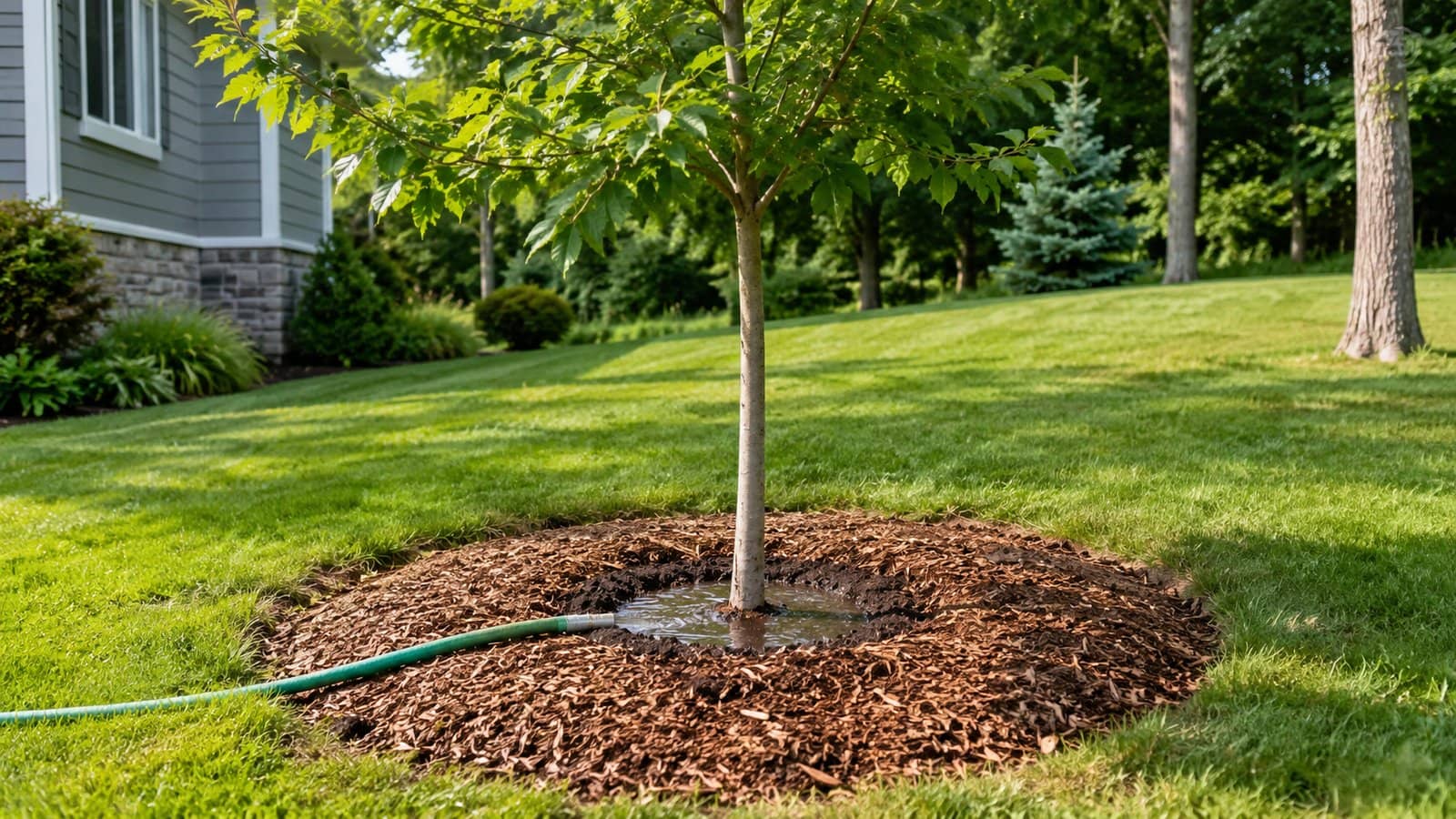
The first year is about root establishment
When a tree is newly planted, most of its usable roots are still confined to the root ball and the backfill area around it. It cannot yet search a wide area for water the way an established tree can. For that first season, your watering routine is what keeps the tree alive while new roots grow into the surrounding soil.
The University of Minnesota Extension gives a simple schedule for newly planted trees and shrubs: water daily for the first 1 to 2 weeks, every 2 to 3 days from weeks 3 to 12, and weekly after 12 weeks until roots are established. Skip a watering only when you receive a substantial soaking rain, roughly more than 1 inch in a day. (Source: University of Minnesota Extension.)
How much water does a new tree need?
A useful starting point is 1 to 1.5 gallons of water per inch of trunk caliper at each watering. A 2-inch caliper tree, for example, may need about 2 to 3 gallons each time in the early schedule. As roots expand, the watering area should expand too.
Many watering bags hold about 14 to 15 gallons and release water slowly over several hours. They can be helpful, but they are not magic. They still need to be filled on schedule, removed or adjusted so they do not trap moisture against bark, and checked so water is reaching the root ball rather than running away from it.
Water slowly and in the right place
Quick sprays from a hose often wet the surface and miss the root ball. A slow trickle, watering bag, or small soil basin around the planting area gives water time to soak down where roots can use it. Focus on the root ball and the surrounding backfill soil, not just the outer edge of the mulch ring.
Clay soils common in parts of the Chippewa Valley can hold water for a long time. Sandy or gravelly soils may dry faster. That is why a schedule is a guide, not a substitute for checking the soil.
Check moisture before guessing
Push a finger or small trowel a few inches into the soil near the root ball. If it is dry and crumbly, water. If it is cool and slightly moist, you are in the right range. If it is soupy, smells sour, or leaves are yellowing while the soil stays wet, back off and improve drainage if needed.
Both drought and overwatering can make leaves wilt, so do not diagnose from leaves alone. Soil moisture tells the truth.
Mulch makes watering work better
A flat 3-inch ring of organic mulch helps hold moisture, reduce turf competition, protect roots from temperature swings, and keep mowers away from the trunk. Make the ring as wide as practical, especially for a young shade tree planted in lawn.
Keep mulch off the trunk and leave the root flare visible. A mulch volcano can keep bark wet, invite decay, and hide planting-depth problems. If the tree looks like a telephone pole coming out of mulch, pull the mulch back and find the flare.
How long until the tree is established?
Small trees establish faster than large ones. A modest young tree may need careful watering for two growing seasons, while larger caliper trees can take several years to fully establish. Drought years stretch that timeline.
The best approach is steady care: water consistently, keep mulch maintained, avoid trunk damage, and do only light corrective pruning while the tree settles in. Good planting and first-year care matter more than almost anything else you can do after the tree is in the ground.
Talk to a local arborist
If you are planting a new tree or worried one is struggling, Wellner Arboriculture can help with placement, planting, and early care. Reach out or call (715) 313-0550.