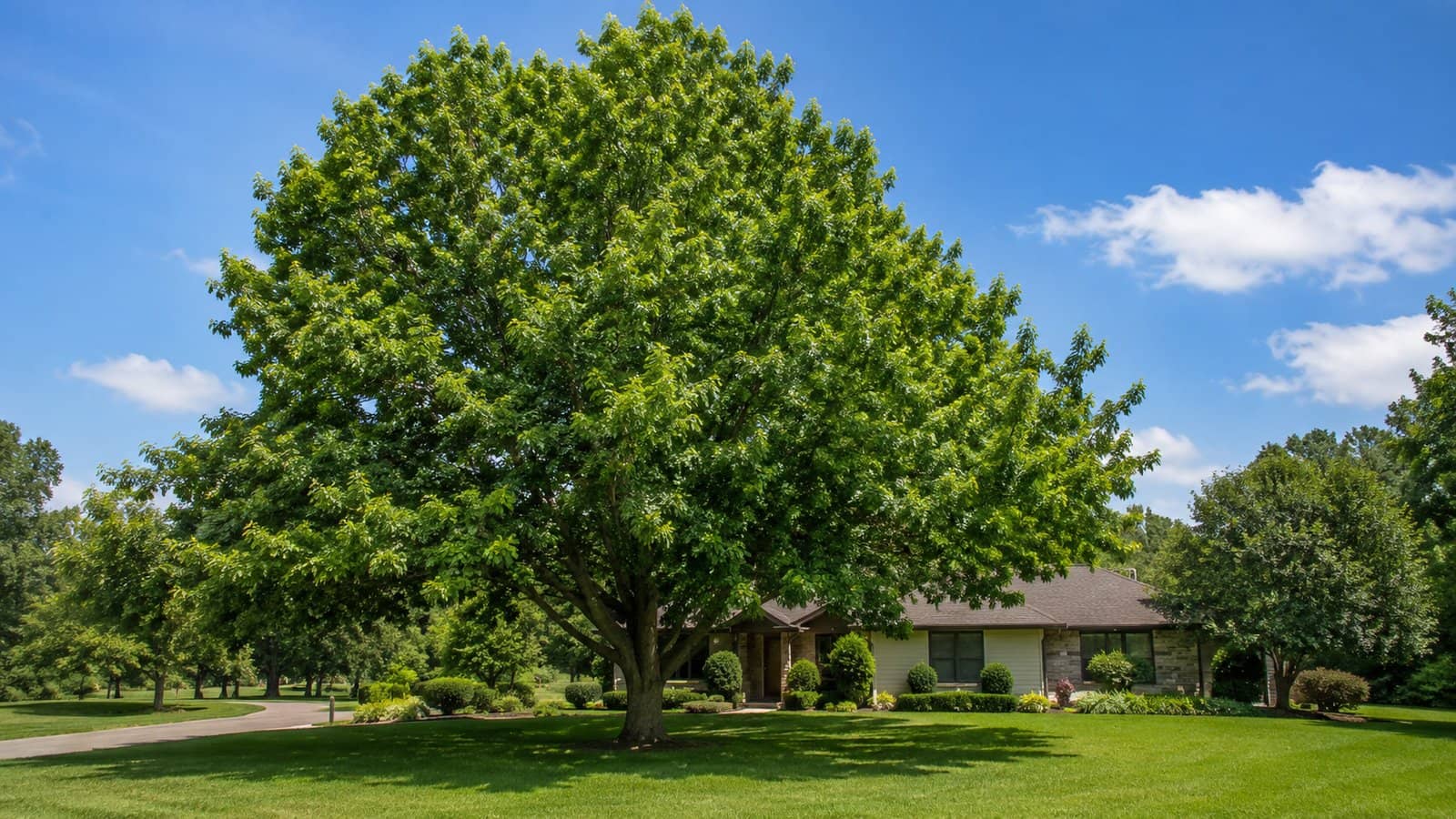
Start with hardiness, then look at the site
Most of the Chippewa Valley sits around USDA hardiness zones 4b to 5a, depending on exact location, elevation, and microclimate. The USDA map is based on average annual extreme minimum winter temperatures, which makes it a useful starting point for choosing long-lived trees. (Source: USDA Plant Hardiness Zone Map.)
Hardiness is only the first filter. A good shade tree for Eau Claire also has to fit the soil, drainage, sunlight, salt exposure, overhead wires, and mature space available. A tree that thrives in a wet low spot may struggle on a windy hill. A tree that looks perfect in a park may be too large for a narrow city lot.
Reliable large shade trees
Bur oak is one of the toughest native trees in Wisconsin. It is slow to moderate growing, deeply rooted, long-lived, and tolerant of drought once established. It needs room, but in the right spot it becomes a legacy tree.
Swamp white oak is worth considering where soil stays damp or clay-heavy. Despite the name, it is adaptable and handles many landscape conditions. UW-Madison Extension notes that swamp white oak tolerates poorly drained soil and is hardy to zone 4a. (Source: UW-Madison Extension.)
Northern red oak grows faster than bur oak and gives strong fall color. It still needs good space and careful pruning when young so it develops a sound branch structure. Because of oak wilt, plan major pruning for the dormant season.
Adaptable trees for tougher yards
Common hackberry is underused and very practical. It tolerates clay, sandy soil, urban heat, and wind better than many more famous shade trees. Its textured bark adds winter interest, and its fruit supports birds.
Kentucky coffeetree is another durable choice for many urban and suburban sites. Male cultivars are often selected to avoid the large seed pods produced by female trees. It has an open canopy, bold winter form, and good tolerance for compacted or difficult soils.
River birch is a strong option for moist areas and low spots where many trees would struggle. It grows relatively fast and has attractive peeling bark. It is not the answer for every dry boulevard or exposed hill, but in the right soil it performs well.
Smaller shade for tighter spaces
Not every property has room for a 70-foot oak. Ironwood, also called hophornbeam, is a hardy native that often matures around 30 feet. It fits smaller yards, edges, and understory spaces better than a large shade tree. Serviceberry, hawthorn, disease-resistant crabapple, and Japanese tree lilac can also work where the goal is filtered shade, flowers, or a smaller canopy.
What to avoid planting more of
Ash was once a common landscape tree, but emerald ash borer has changed that. Since EAB is now confirmed across Wisconsin, planting more ash creates future risk. It is better to use that space for a different species and add diversity to the neighborhood canopy.
Fast-growing trees such as silver maple, willow, and poplar can be useful in the right large, open setting, but they are often poor choices near foundations, sewer laterals, sidewalks, and roofs. Speed is tempting, but weak wood and aggressive roots can create long-term maintenance problems.
Plant for the mature tree, not the nursery tree
Before you plant, picture the tree at full size. Will the crown hit the roof? Will branches grow into service lines? Will the roots be squeezed between a driveway and a foundation? Good tree selection is really good future planning.
Wellner Arboriculture can help match a tree to the actual site, not just the wish list. Our tree planting work focuses on species selection, placement, proper depth, mulch, and the first-year watering plan so the tree has a real chance to establish.
Talk to a local arborist
Planning a shade tree for a yard in Eau Claire, Boyd, Chippewa Falls, or nearby? Ask us what fits or call (715) 313-0550.