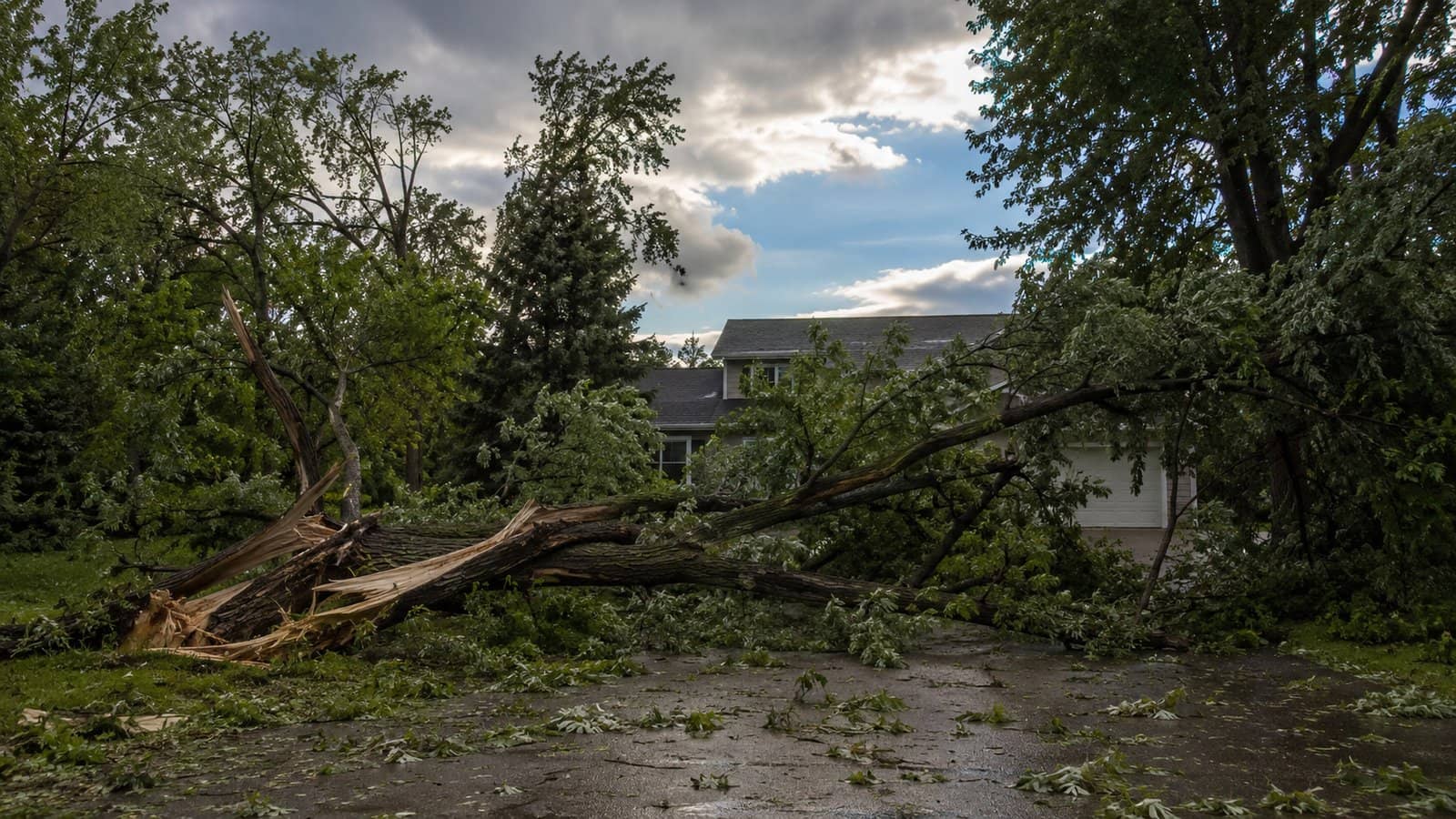
Start with people, power, and access
After a storm, the first question is not whether the tree can be saved. It is whether everyone is safe. Stay away from downed power lines, sagging service drops, and any branch or trunk touching a line. Treat every wire as live and call the utility or emergency services when power lines, roads, structures, or blocked exits are involved.
If a tree is leaning on a house, blocking the only driveway, resting on a vehicle, or hanging over a walkway, keep people out of the area. Do not let children, pets, or curious neighbors stand under damaged limbs while you decide what to do.
Do not rush into cutting
Storm wood is unpredictable. A limb can be under spring tension, a trunk can roll when one cut releases weight, and a hanging branch can drop from the canopy with no warning. Chainsaw work on storm-damaged trees is much more dangerous than cutting clean firewood on the ground.
Work you might handle on a calm Saturday, such as trimming small branches, becomes different when limbs are twisted, split, pinned, or suspended. When in doubt, step back and call for emergency storm cleanup.
Document the damage from a safe distance
If insurance may be involved, take photos before cleanup begins, but only from a safe location. Photograph the whole tree, the damaged area, any impact to structures, and the surrounding context. Do not climb onto roofs, lean ladders against broken trees, or walk under hanging limbs to get a better angle.
Keep notes about the date and time of the storm and any calls made to the utility, insurance company, or tree service. That record can make the cleanup and claim process smoother.
What needs urgent attention?
Call promptly when you see a large limb hanging over a target, a split trunk, a new lean, exposed or lifted roots, a tree resting on a structure, or damage involving utility lines. A tree that shifted in the storm can continue moving after the wind has passed.
Smaller broken branches, minor twig loss, and cosmetic canopy damage can usually wait until the immediate safety hazards are handled. It is often better to prune carefully after the situation is stable than to make rushed cuts during cleanup.
Can the tree be saved?
Many storm-damaged trees can be retained with proper pruning. If the trunk is sound, the main structure is intact, and the canopy loss is not extreme, the tree may recover well. Clean pruning cuts can remove torn branches and reduce decay risk.
Removal becomes more likely when the trunk is split, the root plate has lifted, the tree lost a major portion of its crown, or the remaining structure is aimed at a house, driveway, road, or utility area. The decision should consider both tree health and target risk.
Hidden damage can show up later
A tree may look mostly fine after a storm but still have cracked unions, internal splits, root movement, or broken limbs lodged high in the canopy. Watch it during the weeks that follow. New leaning, wilting on one side, bark cracks, or branches dying back can point to damage that was not obvious on day one.
For valuable trees near homes or public areas, a follow-up tree risk assessment is a wise step after a major wind or ice event.
Talk to a local arborist
When storms hit the Chippewa Valley, Wellner Arboriculture can help with cleanup, pruning, removals, and safety assessments. Contact us or call (715) 313-0550.