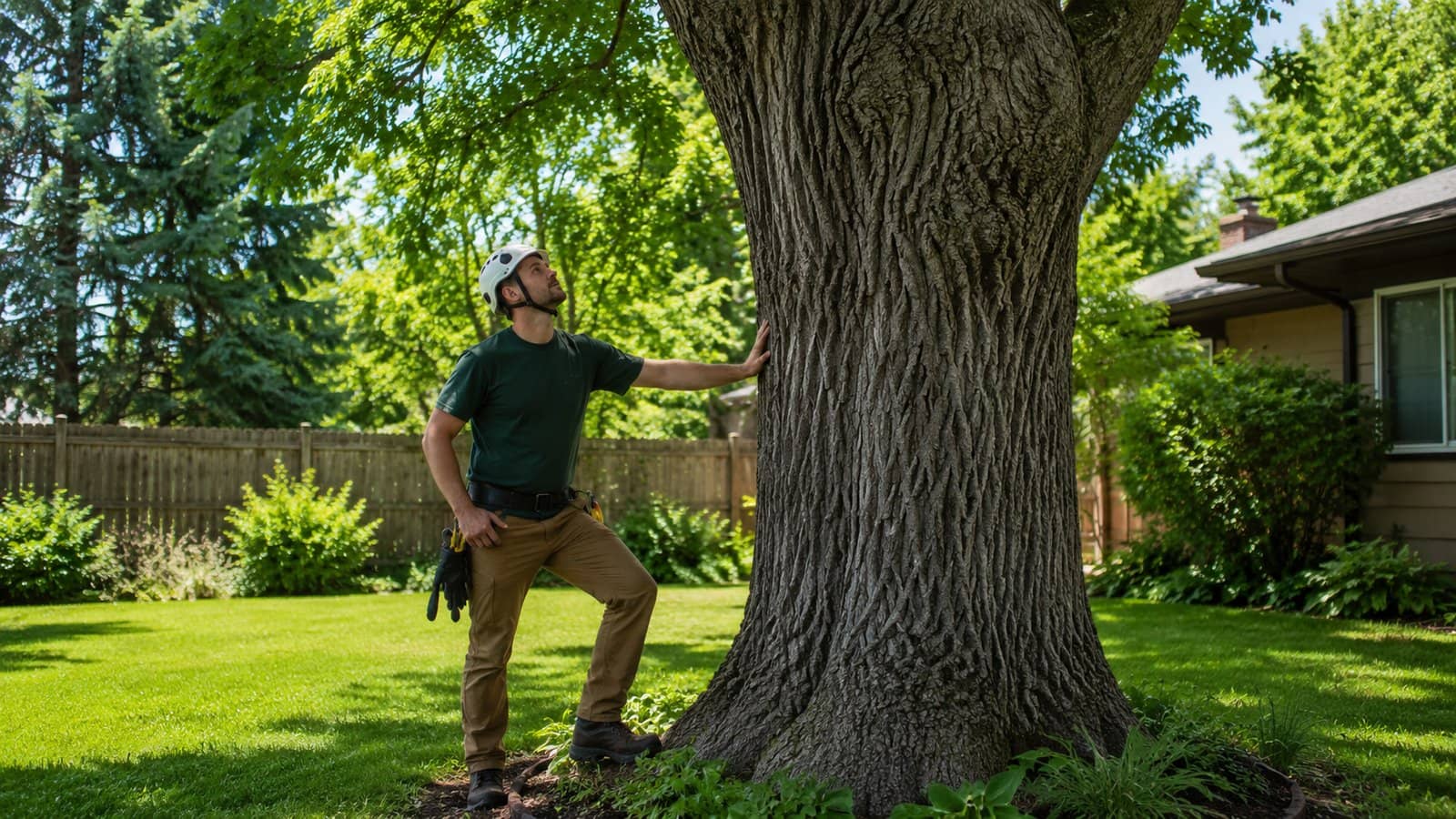
Many tree problems are really branch problems
A tree that looks messy, crowded, or intimidating may not need removal. It may need thoughtful pruning. Dead limbs, broken branches, roof clearance, low limbs over a driveway, rubbing branches, and early structural issues can often be corrected without losing the tree.
Good tree pruning is selective. It removes what is dead, damaged, weak, crossing, poorly attached, or growing into the wrong space while keeping enough healthy canopy for the tree to keep feeding itself. The goal is not to make the tree smaller at all costs. The goal is to make it safer, healthier, and better suited to the site.
When pruning is usually the right answer
Pruning is often the best choice when the trunk and root system are sound, the canopy is mostly alive, and the problem can be isolated to specific branches. Examples include a limb brushing the roof, branches blocking sight lines, a few dead limbs in an otherwise healthy crown, storm-broken branches that did not split the trunk, or young trees that need structural correction.
Pruning can also reduce future risk. Removing a weakly attached limb while it is still small is far easier than dealing with a split trunk ten years later. This is especially important for fast-growing maples and other trees that form tight unions.
When removal is the honest answer
Sometimes pruning only delays the inevitable. Tree removal is more likely when the tree is dead or mostly dead, the trunk has severe decay, major roots have failed, the tree developed a new lean after a storm, or the main stem has split. A tree hollowed or weakened by emerald ash borer is a common example.
Location can also make removal the responsible choice. A compromised tree over a house, garage, service line, septic area, driveway, or public sidewalk carries more consequence than the same tree standing in a back woodlot.
The questions an arborist asks
When we look at a tree, we are weighing several things at once. How much live canopy remains? Is decay present, and where? Are the roots stable? Is the defect likely to worsen? What would the tree or limb hit if it failed? Can pruning reduce the risk to a reasonable level, or would it remove so much canopy that the tree could not recover?
Those answers usually point toward one of three recommendations: prune and retain, monitor and reassess, or remove. The best answer is not always the most expensive one, and it is not always the answer a homeowner feared.
Beware of topping as a middle ground
Topping is often sold as a compromise between pruning and removal, but it usually creates worse problems. Cutting large limbs back to stubs causes decay, weak sprouts, sunscald, and an unstable canopy. A topped tree may look smaller for a moment, but the new growth is often more likely to break later.
If a tree has to be cut back so hard that proper pruning cannot preserve its structure, removal and replacement may be the better long-term plan.
Think beyond this season
A good decision accounts for how the tree will look and behave five or ten years from now. If pruning can give a healthy tree more safe life, it is worth preserving. If removal opens the chance to plant the right species in the right place, that can be the better investment.
Talk to a local arborist
If you are unsure whether a tree needs pruning or removal, Wellner Arboriculture can give you a clear recommendation. Reach out or call (715) 313-0550.