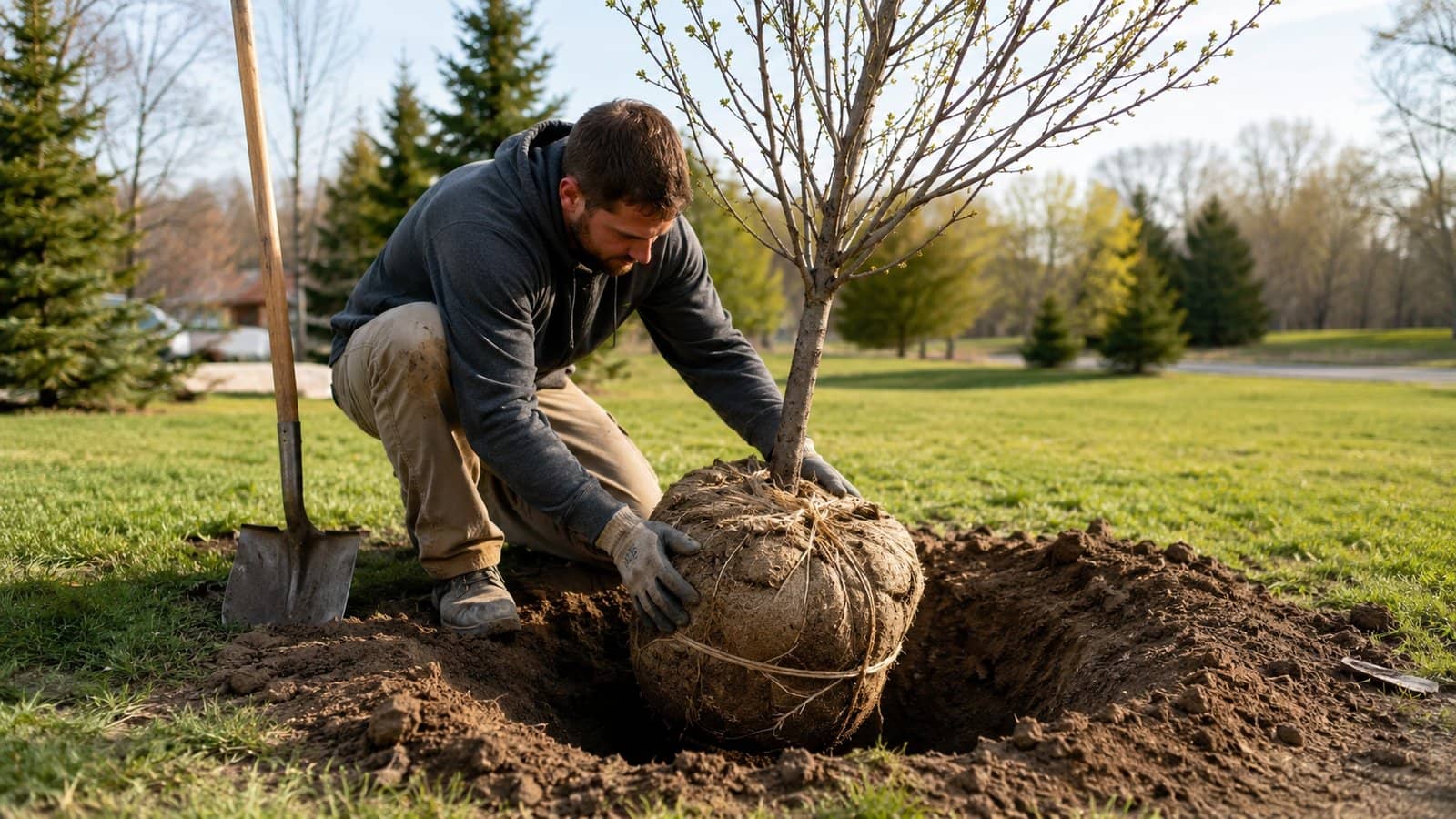
Spring and early fall are the main windows
For most Wisconsin homeowners, the best times to plant trees are spring after the ground has thawed and early fall before the ground freezes. Both windows give roots time to grow without the worst pressure of summer heat or deep winter cold.
Spring is the traditional choice. Soil moisture is usually better, nursery stock is fresh, and the tree has a full growing season ahead. Early fall can also be excellent because soil is still warm enough for root growth while cooler air reduces canopy stress.
Spring planting
Spring is especially good for bare-root trees and many species that benefit from a full season to settle in. Plant once the soil is workable, not when it is still smeared, frozen, or waterlogged. A tree planted into compacted mud starts life with poor soil structure around the roots.
Spring planting still requires watering. Rainy weather can be misleading, especially if the root ball dries out inside the planting hole. Check soil moisture rather than assuming the weather has handled it.
Fall planting
UW-Madison Extension lists many species that can be planted in fall, generally September into early October, weather permitting. Hackberry, linden, many maples, crabapple, honeylocust, and several others can do well in that window. (Source: UW-Madison Extension.)
Some trees may be better saved for spring or planted with extra care in fall, including oak, birch, beech, magnolia, poplar, willow, and evergreens. Extension notes that evergreens can still be planted in fall, but they should go in earlier, around mid-August to September, and be watered properly.
Summer is possible, but harder
Summer planting is not impossible, but it is less forgiving. Heat, drought, and transplant shock arrive at the same time. If you must plant in summer, choose healthy container stock, plant early in the day, water consistently, and avoid letting the root ball dry out even once.
Summer is also a poor time for oversized planting ambitions. A smaller, healthy tree planted well often outperforms a large tree that struggles through heat with a limited root system.
Timing does not fix bad planting
The calendar helps, but planting technique matters more. Set the tree at the right depth with the root flare visible. Remove circling roots when needed. Backfill with the native soil unless there is a specific reason to amend. Mulch wide and flat, not against the trunk.
Do not plant under power lines unless the mature size fits. Do not place a large shade tree too close to the house just because it looks small in the pot. The best planting decision considers the tree at full size.
Aftercare decides success
A newly planted tree needs consistent watering until roots establish. That can take more than one season, especially for larger trees. Mulch, watering, and mower protection are the three basics that matter most after planting day.
Wellner Arboriculture can help with tree planting, species selection, placement, and care instructions so the tree has a strong start in Chippewa Valley conditions.
Talk to a local arborist
Thinking about planting a tree this spring or fall? Ask us what timing and species make sense or call (715) 313-0550.