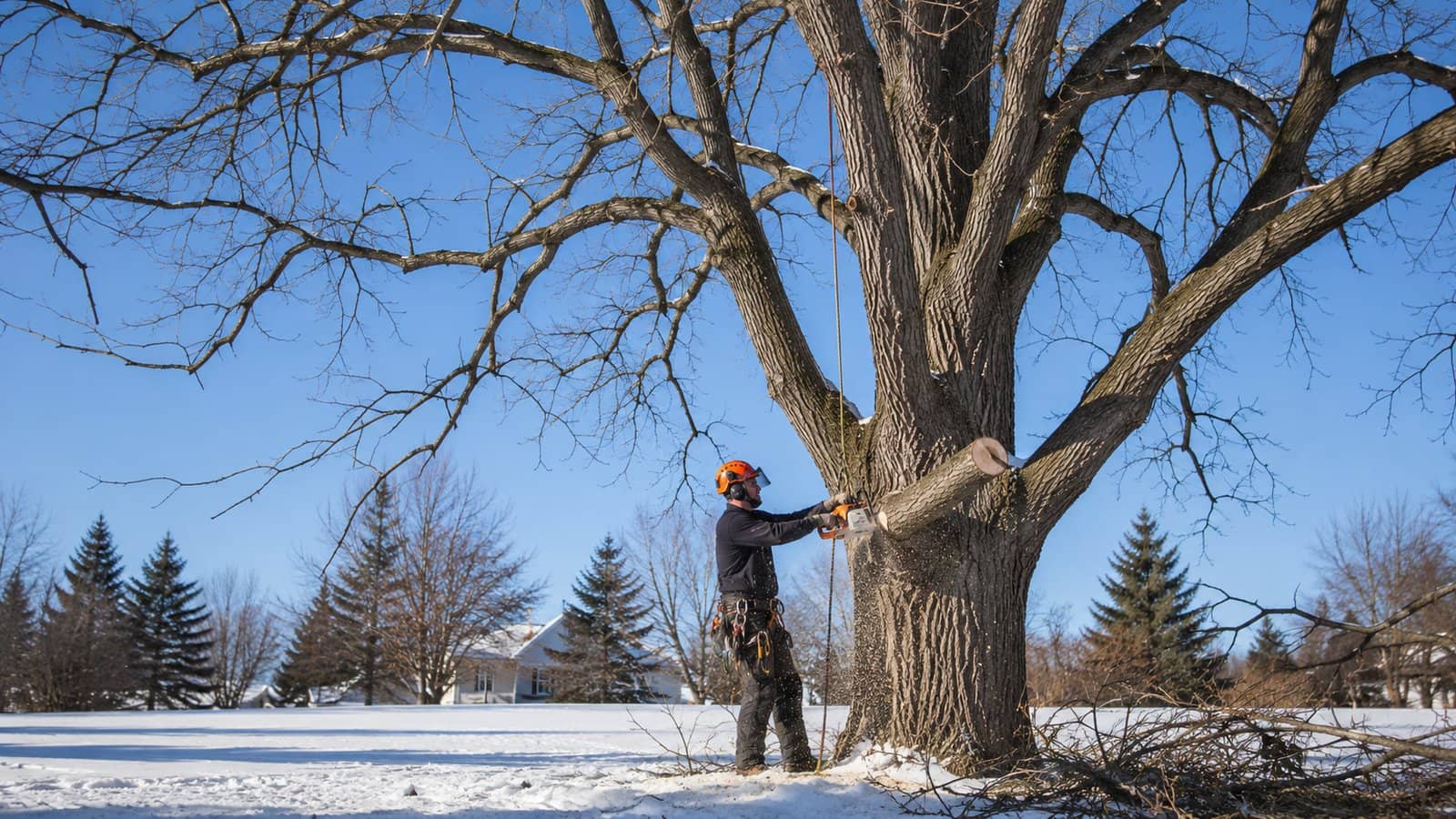
Why oak pruning timing matters in Wisconsin
Oak trees are some of the strongest, longest-lived shade trees in the Chippewa Valley, but they have one timing rule that deserves real respect: avoid unnecessary pruning during oak wilt season. Oak wilt is a fungal disease that moves through a tree’s water-conducting tissue and can kill red oaks very quickly once symptoms appear.
The Wisconsin DNR explains that oak wilt spreads in two main ways. Underground, it can move through connected root systems between nearby oaks. Above ground, sap-feeding beetles can carry spores from infected trees to fresh wounds on healthy trees. That second pathway is why pruning at the wrong time can turn a simple maintenance cut into a serious disease risk. (Source: Wisconsin DNR.)
The safest time to prune oaks
The safest window for pruning oak trees in Wisconsin is the dormant season, after leaf drop and before spring growth begins. Late fall and winter are ideal because the insects that spread oak wilt are not active and the tree is not pushing new growth.
The DNR identifies spring and early summer as the greatest risk period. In urban and residential areas, the broad homeowner rule is to avoid pruning or wounding oaks from April through July. For forestry work, restricted periods vary by location, with northern Wisconsin commonly listed as April 15 to July 15 and southern Wisconsin as April 1 to July 15. For extra caution, many arborists avoid nonessential oak pruning until the weather is consistently cool again.
Red oaks are especially vulnerable
Oak wilt is most aggressive in the red oak group, including northern red oak, black oak, and pin oak. Once visible wilting starts, red oaks can lose leaves and die in a short period of time. Leaves may bronze or wilt from the top of the canopy downward and can drop while they are still partly green.
White oaks, bur oaks, and swamp white oaks tend to be more tolerant, but that does not mean they are immune. They can still become infected, decline over time, and contribute to disease spread in a stand or neighborhood. The safest habit is to treat all oaks with the same seasonal care.
What if a storm breaks an oak limb in summer?
Storm damage does not wait for the right season. If an oak is wounded during the high-risk months, the DNR recommends applying tree wound sealer immediately to the fresh wound. This is one of the few situations where wound dressing is recommended, because the goal is to block beetles from reaching the cut surface. For routine pruning outside oak wilt season, wound sealers are generally not needed.
Do not climb into a storm-damaged oak or cut loaded limbs without the right equipment. Split wood, hanging branches, and tensioned limbs can shift suddenly. If the damage is above a driveway, roof, utility line, or play area, it is a good situation for storm cleanup or a risk assessment.
Good pruning still matters
Timing reduces disease risk, but cut quality affects the tree for years. Proper oak pruning removes dead, broken, rubbing, or poorly attached limbs without stripping the canopy. A good cut is made just outside the branch collar, not flush against the trunk and not far out on a stub. Flush cuts slow wound closure, while stubs die back and invite decay.
For mature oaks, less is often more. Removing too much live canopy in one visit can stress the tree, especially after drought, construction damage, or root disturbance. The best plan is usually targeted structural pruning done in the right season.
Talk to a local arborist
If your oak needs pruning or you are worried about oak wilt, Wellner Arboriculture can help you choose the right timing and scope. Reach out or call (715) 313-0550.