Emerald ash borer is already part of Wisconsin tree care
Emerald ash borer, often shortened to EAB, is a small invasive beetle that attacks ash trees. The adults are easy to overlook, but the larvae cause the real damage. They feed under the bark and interrupt the tree’s ability to move water and nutrients from the roots to the canopy. Once that system is badly damaged, the tree declines quickly.
UW-Madison Extension notes that, as of 2024, EAB has been confirmed in all 72 Wisconsin counties. That means homeowners in Eau Claire, Chippewa Falls, Boyd, Altoona, Lake Hallie, and the surrounding Chippewa Valley should assume ash trees are at risk rather than waiting for an official neighborhood notice. (Source: UW-Madison Extension.)
The difficult part is that an ash can look mostly normal while EAB is already working inside it. By the time the top third of the crown is thinning, the tree may have been infested for several years. Dead ash also becomes brittle faster than many homeowners expect, which makes delayed removal more dangerous and often more expensive.
Signs that EAB may be active
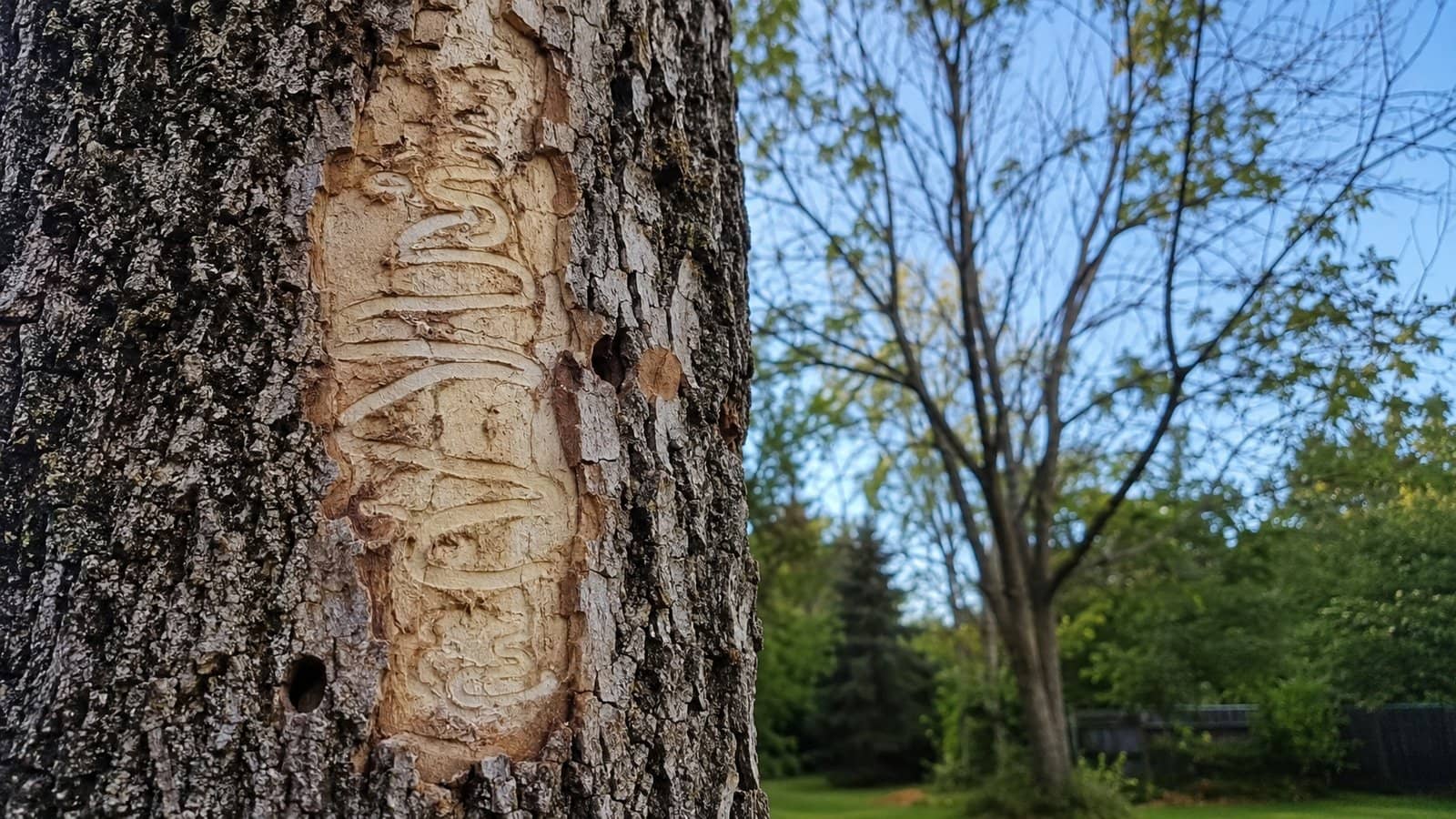
Canopy thinning near the top of the tree is one of the most common early symptoms. You may also see sprouts growing from the trunk or main limbs, vertical bark splits, heavy woodpecker activity, or patches of bark that look blond where birds have flaked off the outer layer. More specific signs include small D-shaped exit holes and S-shaped galleries under loose bark.
Those symptoms can overlap with drought stress, old pruning wounds, compacted soil, and other insects, so the goal is not to diagnose from one clue. The better question is whether the ash is healthy enough, valuable enough, and well placed enough to justify a long-term treatment plan.
Treat or remove? Start with the canopy
A practical guideline is the 50 percent canopy rule. Ash trees with less than about half of the canopy thinned or lost are usually better candidates for treatment. If more than half the crown is dead or thin, the tree is often too far gone for treatment to be a good investment.
Location matters too. A healthy ash shading the west side of a house may be worth protecting. A declining ash leaning over a driveway, fence, garage, septic area, or utility line may be a better candidate for planned tree removal. The earlier that decision is made, the more control you have over timing and safety.
What treatment really means
EAB treatment is not a one-time cure. Homeowner products are usually soil drenches used on smaller trees, while larger or higher-value trees are commonly protected with professional trunk injections. UW-Madison Extension notes that some products require yearly use, while emamectin benzoate trunk injections are labeled for two years of protection. (Source: UW-Madison Extension.)
That ongoing commitment is worth thinking through. If the tree is vigorous, structurally sound, and important to the property, treatment can preserve years of shade. If the tree is already declining or poorly located, putting that money toward removal and a better replacement tree may be the smarter long-term choice.
Replacement is part of the plan
One mistake after EAB is replacing an ash with another ash or planting several of the same species in a row. A more resilient yard uses diversity. Bur oak, swamp white oak, hackberry, Kentucky coffeetree, river birch, ironwood, and other hardy species can all be good choices depending on soil, space, sunlight, and overhead wires.
If you are unsure what kind of ash you have or how much useful life is left in it, a tree risk assessment gives you a clearer answer. We can look at canopy condition, trunk defects, targets, access, and replacement options so you are not guessing from the driveway.
Talk to a local arborist
Have an ash tree you are trying to make a decision on? Wellner Arboriculture gives straightforward, no-pressure advice across Eau Claire and the Chippewa Valley. Get in touch or call (715) 313-0550.