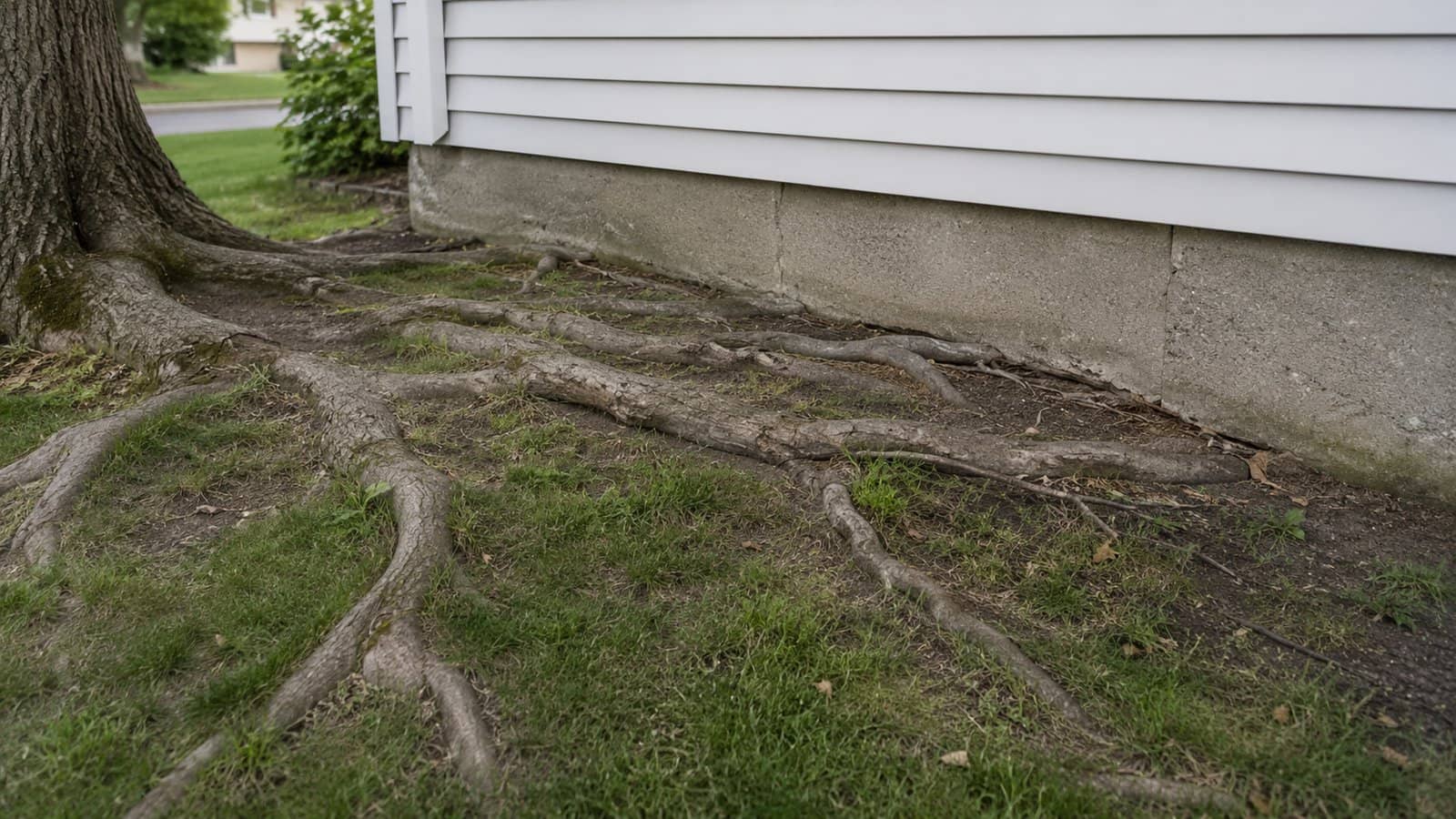
Roots follow opportunity
Tree roots are not underground drill bits looking for concrete to destroy. They grow where they find oxygen, moisture, and usable soil. Most absorbing roots are in the upper layers of soil, and many spread well beyond the dripline of the tree.
Problems happen when roots find a weakness: a leaking pipe joint, a cracked sewer lateral, loose backfill, compacted soil, or a foundation area already stressed by drainage and soil movement. The tree may not be the original cause, but roots can make an existing problem worse.
Foundations: usually more about soil than force
Healthy roots rarely break through a sound foundation on their own. In heavy clay soils, the bigger issue is moisture movement. Clay expands when wet and shrinks when dry. Large trees can draw moisture from the soil near a foundation during dry periods, and uneven soil shrinkage can contribute to settling or cracking where other conditions are already present.
That does not mean every large tree near a house is a problem. Many homes and mature trees coexist for decades. Risk is higher when a large, thirsty tree is very close to the foundation, drainage is poor, soil is highly shrink-swell, or the foundation already has cracks.
Sewer lines are a different story
Sewer and drain lines offer exactly what roots want: moisture, air, and nutrients. Roots do not need a large opening to start. A fine root can enter a small crack or loose joint, then grow inside the pipe and catch debris. Over time, that can cause slow drains, backups, and repeated cleanouts.
Older clay tile, cast iron, concrete, and Orangeburg pipes are more vulnerable than newer sealed lines, but no pipe with a defect is immune. If you have recurring backups and mature trees near the lateral, a sewer camera inspection is often the clearest next step.
Warning signs of root-related pipe issues
Slow drains throughout the house, gurgling toilets, sewer odors, recurring backups, or a cleanout that repeatedly fills with roots all point toward a line problem. Tree species alone does not prove the cause, but fast-growing water-seeking trees near old sewer lines raise the suspicion.
For foundations, watch for new cracks, doors or windows sticking, uneven settling, or soil pulling away from the foundation during drought. Those signs deserve evaluation by the right professional, because drainage, gutters, grading, soil, and construction issues may all be involved.
Prevention at planting time
The best fix is spacing. Keep large shade trees well away from foundations and underground lines when possible. Give extra distance to willow, silver maple, poplar, and other fast-growing species with aggressive root systems. Choose smaller trees for narrow side yards and tight urban lots.
Before planting, call for utility markings and think about the sewer lateral route, septic field, water line, sidewalks, driveway, and future additions. A tree planted in the right place rarely becomes a root problem.
What if the tree is already there?
Do not cut large roots without guidance. Major root cutting can destabilize the tree and create decay. If roots are damaging hardscape, invading a pipe, or growing too close to a foundation, the right answer may involve plumbing repair, drainage correction, selective pruning, root barriers, or in some cases tree removal.
A healthy tree is valuable, so the decision should be based on actual evidence, not fear. A camera inspection, site assessment, and clear understanding of the species and targets can prevent unnecessary removal.
Talk to a local arborist
Concerned about roots near a foundation, sewer line, driveway, or sidewalk? Contact Wellner Arboriculture or call (715) 313-0550 for a practical look at the tree side of the problem.