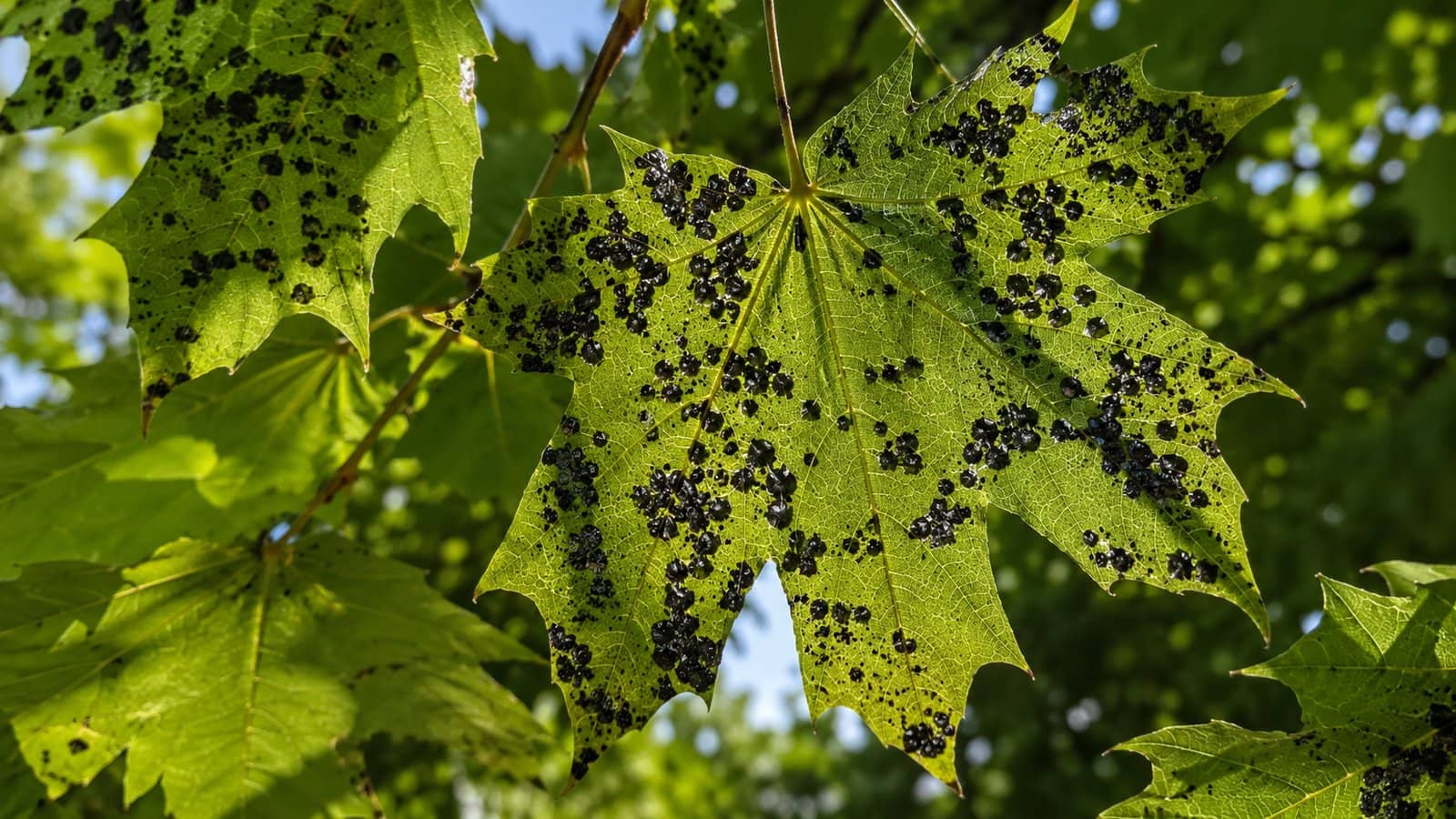
What tar spot looks like
Tar spot is a fungal leaf disease that creates dark, tar-like spots on maple leaves. Early symptoms can start as small yellowish spots. Later in the season, those spots darken into raised black patches that may look glossy, bumpy, or fingerprint-like.
UW-Madison Extension describes tar spot as common, visually distinctive, and primarily cosmetic. It affects several maples, including silver maple, sugar maple, and Norway maple, and can also appear on a few other trees and shrubs. (Source: UW-Madison Extension.)
The good news: it usually does not hurt the tree
Tar spot looks dramatic, but it rarely threatens the health of a mature maple. It affects leaves, not the trunk, roots, or structural wood. A heavily spotted tree may drop some leaves early, but most healthy maples replace those leaves the next spring without lasting harm.
It is also not dangerous to people or pets, and it is not a sign that the maple needs to be removed. In many yards, tar spot is more of an aesthetic nuisance than a plant health problem.
Why it comes back
The fungi that cause tar spot survive in fallen leaves. In spring, spores from infected leaf litter can reinfect new leaves, especially during wet weather. That is why one tree may have spots year after year if leaves are left under the canopy or blown into nearby beds.
Weather matters too. Wet springs and humid summers tend to make foliar diseases more noticeable. A drier year may bring fewer spots even if the fungus is still present in the area.
What to do in fall
The most useful control is simple cleanup. Rake up infected maple leaves and dispose of them, bury them, or hot-compost them. Extension notes that compost piles need to reach high temperatures and be turned so leaves on the outside move into the hot center.
If your neighborhood has many infected maples, cleanup on one property may not eliminate tar spot entirely, but it can reduce the amount of fungus overwintering right under your tree.
Are fungicides worth it?
Fungicides are labeled for tar spot, but they are rarely warranted for mature shade trees. Sprays have to be timed preventively as leaves emerge, and thorough coverage of a large maple is difficult. For most homeowners, fall leaf cleanup is the practical choice.
Fungicide discussions may make sense for a high-value ornamental, a nursery setting, or a young tree with repeated severe defoliation, but that is not the typical yard situation.
When black spots are not the real issue
Tar spot alone is not a reason to panic. However, if the tree also has significant canopy thinning, dead branches, root damage, trunk decay, or early leaf drop unrelated to spots, there may be another problem worth investigating.
A maple can have tar spot and a separate health issue at the same time. The spots may be the most visible symptom without being the most important one.
Talk to a local arborist
If your maple has black spots plus thinning, deadwood, or other decline, Wellner Arboriculture can take a look. Reach out or call (715) 313-0550.