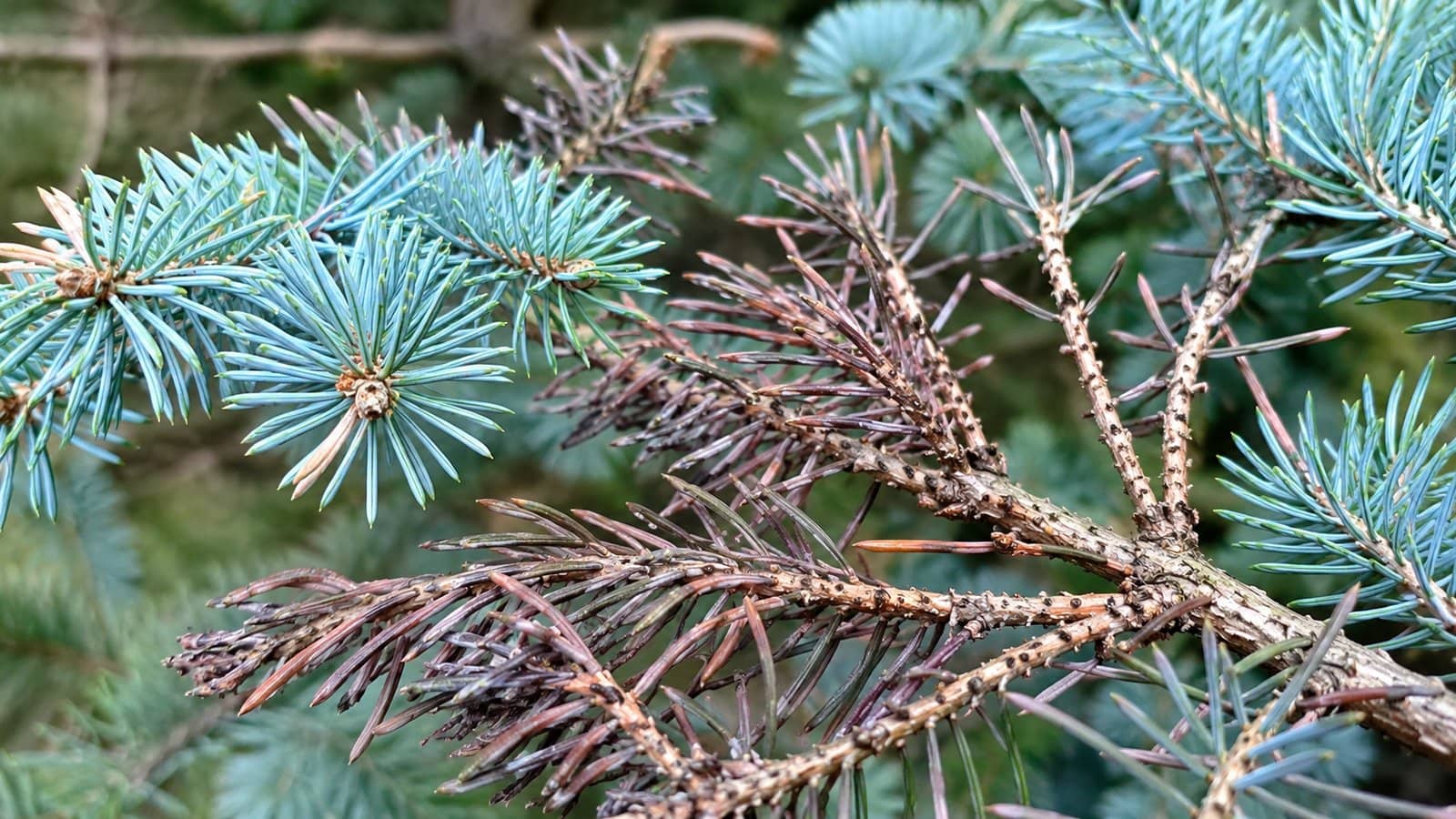
Blue spruce struggles in many Midwest landscapes
Colorado blue spruce was planted heavily across Wisconsin for decades. It is attractive, dense, and familiar, but it is not always happy in our humid summers, heavy soils, crowded windbreaks, and stressful yard conditions. As trees age, browning and branch dieback become more common.
UW-Madison Extension identifies Rhizosphaera needle cast as the most common disease of Colorado blue spruce in Wisconsin. Other problems, including Cytospora canker, drought stress, spider mites, salt exposure, and root stress, can look similar from a distance. (Source: UW-Madison Extension.)
Rhizosphaera needle cast
Rhizosphaera usually starts on the lower inner branches. Older needles turn purplish brown, then drop, while the newest needles at the tips may stay green. Over time, branches look thin, bare on the inside, and tufted at the ends.
A useful clue is rows of tiny black dots on infected needles, visible with a 10X hand lens. These are fungal fruiting bodies. The disease spreads by spores from infected needles, especially during wet weather.
Fungicides labeled for evergreens, often containing copper or chlorothalonil, can help protect new needles from infection, but they do not turn brown needles green again. Extension notes that treatments must be timed as new needles emerge and repeated during wet periods. Large trees are difficult to cover thoroughly, so results vary.
Cytospora canker
Cytospora canker often causes whole branches to die, usually starting low and moving upward. One common sign is whitish or bluish resin on the branch or trunk near the affected area. Unlike Rhizosphaera, there is no spray that cures Cytospora canker.
Management focuses on reducing stress, pruning out dead branches during dry weather, avoiding unnecessary wounds, and improving the growing environment. If much of the lower canopy is already gone, the tree may never regain the full look people expect from blue spruce.
Stress makes disease worse
Blue spruce problems are often a combination, not one simple cause. Tight spacing limits airflow. Wet needles stay infected longer. Heavy clay can stress roots. Drought weakens the tree. Mower damage, mulch against the trunk, and road salt add more pressure.
Helpful care includes a wide mulch ring, watering during drought, keeping sprinklers off the foliage, pruning only dead or diseased material, and improving spacing where possible. Avoid shearing or heavy pruning that traps moisture inside the canopy.
When treatment makes sense
Treatment is most worthwhile when the tree still has a good amount of live canopy and the goal is to protect new growth. It is less promising when a blue spruce has already lost most lower branches, has extensive cankers, or is planted in a site that will keep stressing it.
Sometimes the best answer is not years of spraying. It may be removing a declining spruce and replacing it with a species better suited to the yard, such as white pine, fir, arborvitae, serviceberry, oak, hackberry, or another tree chosen for the actual site.
Talk to a local arborist
If your blue spruce is turning brown, Wellner Arboriculture can help identify the likely cause and whether treatment, pruning, or replacement makes sense. Contact us or call (715) 313-0550.